01
Want the full model?
Community Care
A hands-on path for small departments ready to embed social workers and build a sustainable co-response program from the ground up.
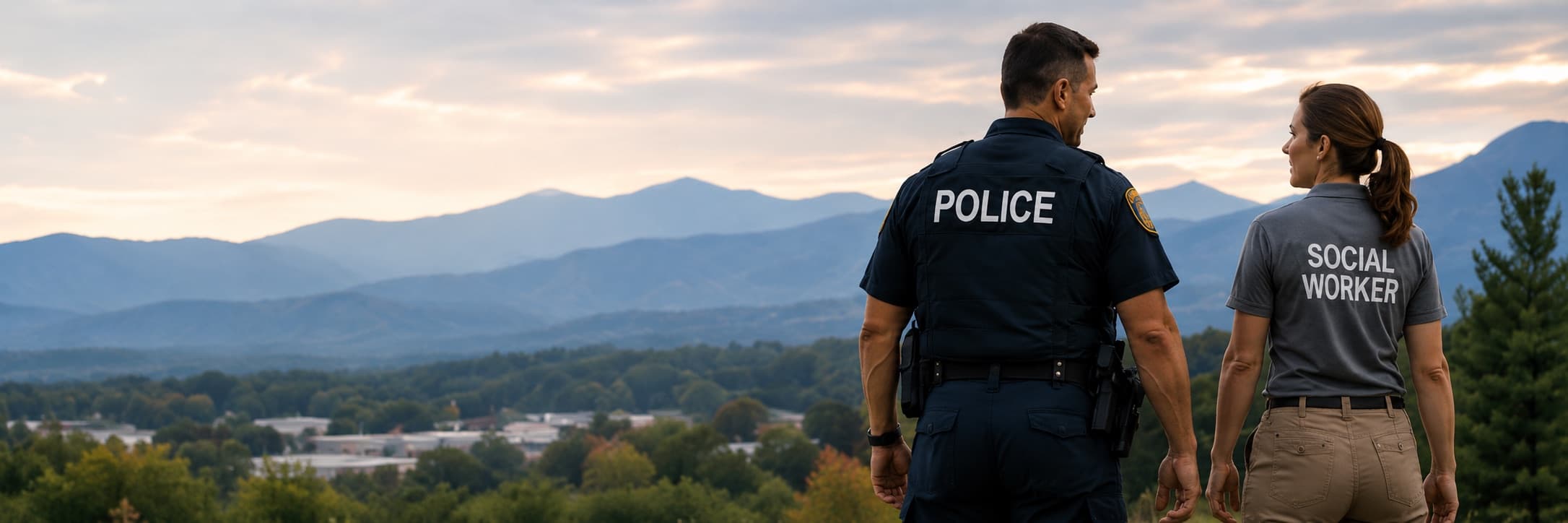
In a small town, the officer answering a mental health call is often the only help available. We help departments put trained social workers beside them.
A proven model, practical tools, workforce connections, and implementation support. Built for small and mid-sized departments.
A proven co-responder model, built for small and rural agencies.
In-person academy, online courses, and the templates to start.
Growing the next generation of police social workers.
Fewer bookings, fewer ER visits, more officer time on patrol.
As seen on
PBS North Carolina · ncIMPACT
When Sylva Police Chief Chris Hatton first heard the idea of sending social work interns alongside officers, he was skeptical. Then he saw one in action.
Watch the segment“I got to see firsthand some of the best police work I’ve ever seen done by an intern, a social work intern.”
What changed his mind was seeing the gap firsthand: when mental illness was driving the call, his officers had few options beyond jail.
“We have jail. That’s what we’re given to handle problems.”
The Community Care model gave officers another option: a social worker who could help in the moment, follow up after the crisis, and connect people to services that police alone could not provide.
Today, Hatton says having a social worker is non-negotiable:
“I wouldn’t want to do this job, not without one.”
Our flagship program, Community Care, began with a single social work intern. There was no program, no budget, and no playbook — just the conviction that an officer answering a behavioral health call shouldn't have to answer it alone.
Since 2021 we've worked with eight law enforcement agencies across the state — and six of them have made the role permanent, four funding the position out of their own budget and two securing grant funding to create it. For a rural department, that is not a line item added lightly.
Now CoResponse Collaborative's mission is to scale and expand the program and trainings beyond Western North Carolina.
Law enforcement has a name for it — frequent flyers. The twenty or so people a department spends eighty percent of its time responding to, none of it for anything a badge can fix. Community Care breaks that cycle by connecting those people to the help that actually works.
We have never recruited an agency. Every one of them came to us.
Community Care sites are concentrated in Western North Carolina — the small and rural departments the model was built for.
One intern in one small department became a model that other agencies asked for by name.
What took years to build in Western North Carolina shouldn't have to be reinvented by every small department in America.
The agencies with the greatest need have had the fewest tools built for them.
Some departments are starting from scratch. Others already have training, staff, partnerships, or policies in place. CoResponse Collaborative is designed to fill the gaps, not make agencies start over.
Want the full model?
A hands-on path for small departments ready to embed social workers and build a sustainable co-response program from the ground up.
Need to prepare your team?
Train officers and social workers, and access the policies, protocols, templates, and practical resources needed to do the work well.
Need the right people?
Connect with a growing pipeline of students and trained police social workers prepared for this specialized work.
Need to show what’s working?
Track calls, services, outcomes, and program impact with tools designed around the realities of co-response.
Use what you need. Build on what you already have.
The CoResponse Collaborative platform gives small departments the training, policies, tools, and support to build a co-response program without starting from scratch.
We're turning years of training, policies, tools, and implementation knowledge into a digital platform.
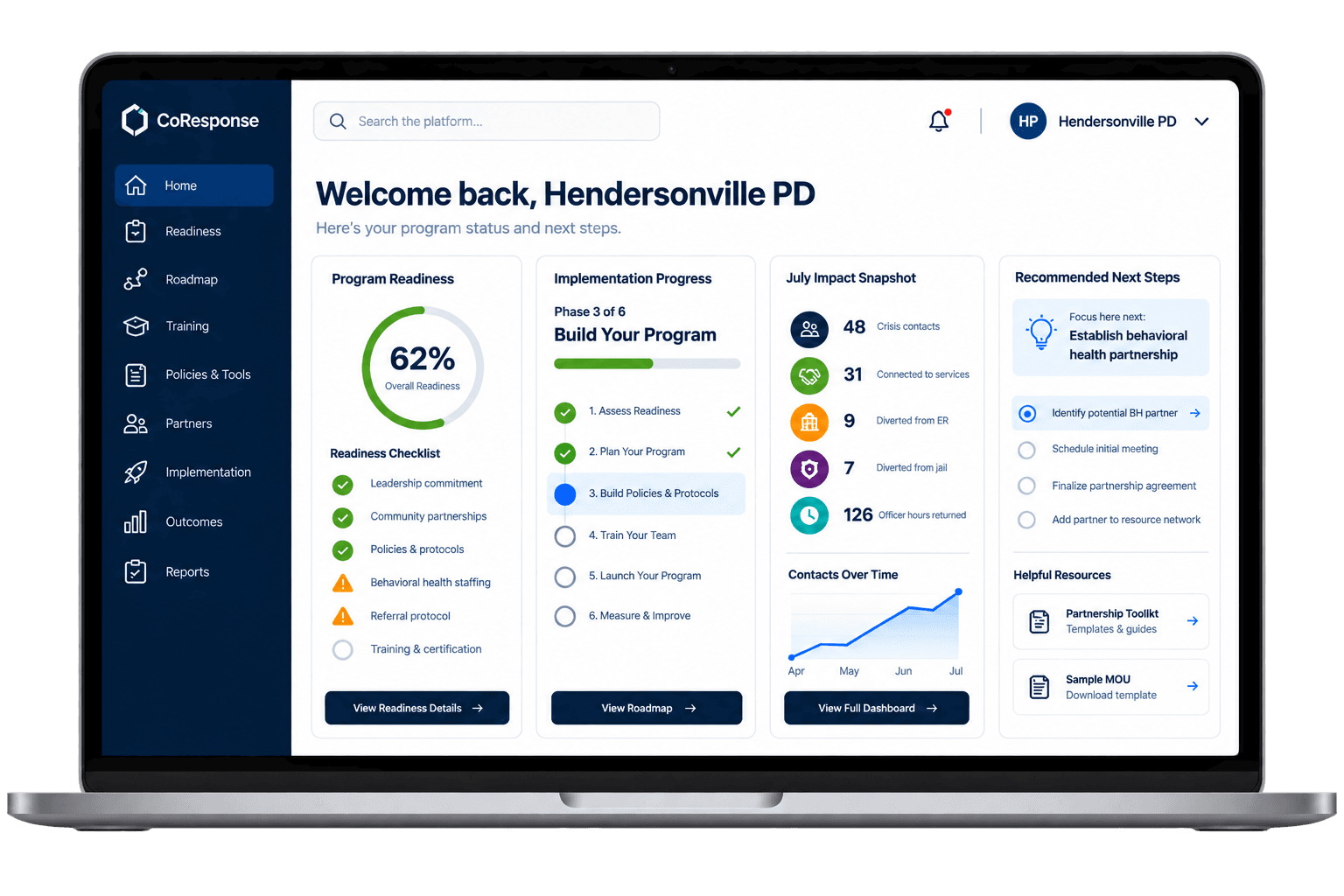
A guided path. Every step. Built for small agencies.
Are we ready?
What do we need to build?
How should our program operate?
Is our team ready?
Are all the pieces in place?
Is it working?
Purpose-built tools for every stage of implementation.
Your agency is
62% ready to launch
Readiness checklist
Recommended next step
Establish behavioral health partnership
See what's missing and what comes next.
Community Care Implementation
Phase 3 of 6 · Build Your Program
Assess Readiness
Plan Your Program
Build Policies & Protocols
Train Your Team
Launch Your Program
Measure & Improve
Follow a proven path from planning to launch.
Crisis Response Protocol
3 items remaining before this policy is launch-ready
Customize field-tested policies and protocols.
Contacts over time
Track impact and report results.
Most co-response training ends when the class does. Agencies still have to figure out staffing, policies, partnerships, referrals, data, and day-to-day operations.
That's the gap CoResponse Collaborative is built to close.
What agencies have today
Send officers to a multi-day training
Return to the department
Write policies from scratch
Navigate partnerships alone
Invent workflows and referral paths
Guess at what to measure
Build, or rebuild, as you go
What we're building
Assess readiness
Plan with a proven roadmap
Prepare policies and partnerships
Train the whole team
Launch with support in place
Measure what actually changed
A department of twelve officers should be able to run the same quality of program as a department of twelve hundred.
Co-response only earns its place if it changes outcomes. Early implementation data from Community Care partner agencies, alongside evidence from comparable national programs, shows reductions in jail utilization, hospital use, and repeat crisis contacts. These are the measures we track at every site.
People in crisis routed toward services instead of custody, when custody was never the right answer.
Care connected earlier, before a hard night becomes an ambulance ride.
Warm handoffs into housing, treatment, and benefits — tracked through to whether they stuck.
Time given back to patrol when a social worker takes the lead on a behavioral health call.
Voluntary, strengths-based contact changes how a department is seen by the people it serves.
The same measures at every site, so agencies can prove impact and keep their program funded.
We are grateful to our partners for helping put co-response into more communities.
 Research and commercialization partner
 Scenario-based training partner
 Supporting statewide expansion
 Platform development partner
…and a network of community partners across North Carolina.
Whether you're a chief exploring the model, a university partner, or a funder — we'd like to hear from you.